🌍 Welcome Home

No matter the distance, the journey is long when home is missed.
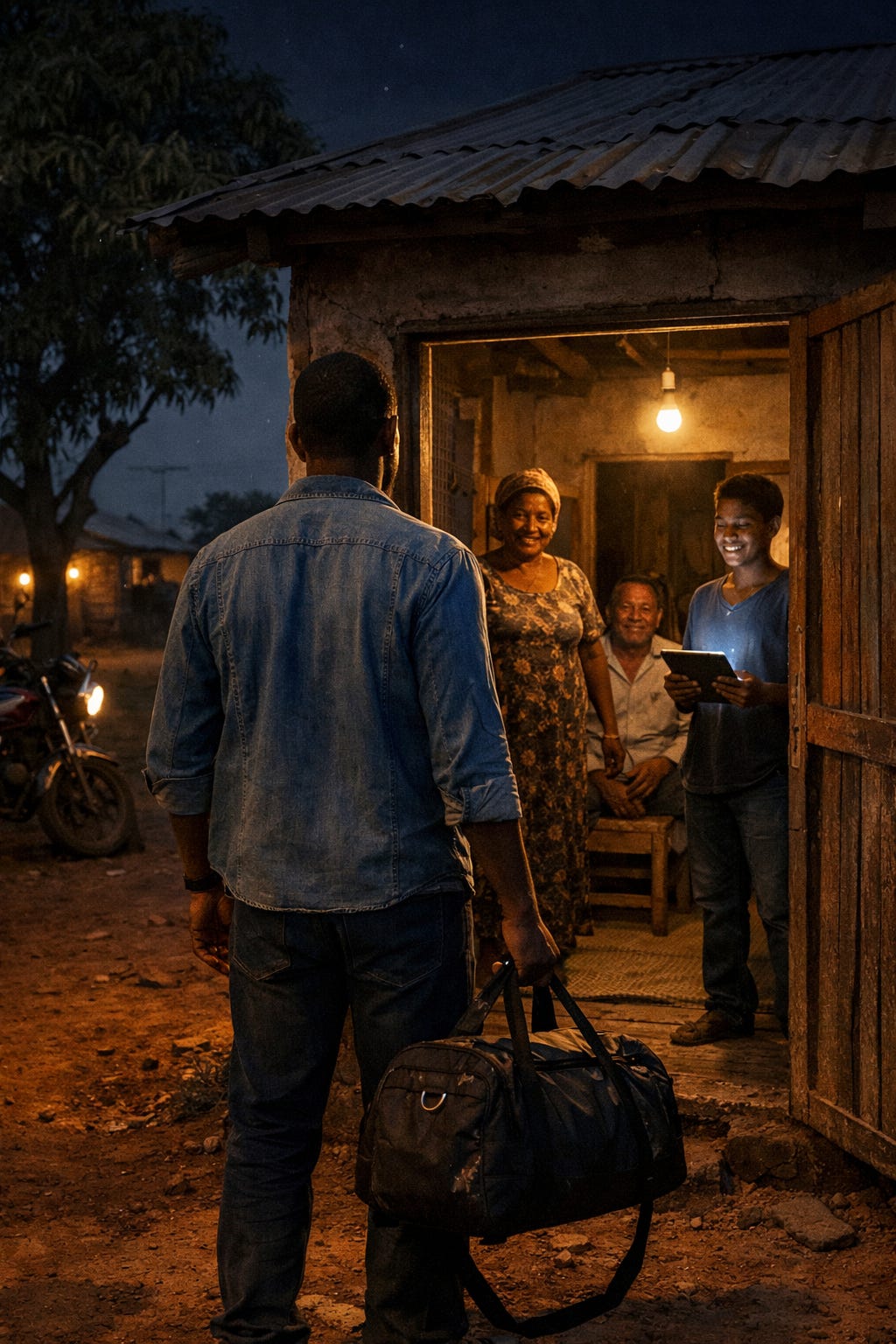
The buses always ran late when the rains had just passed. The road held water in its shallow ribs, reflecting fractured pieces of moonlight like broken glass.
He arrived at night.
He stepped down with one bag.
The bag was heavier than when he left, with wires, screens, unfamiliar voices speaking through headsets, instructions repeated in languages that bent differently around the tongue.
The village did not glow.
It breathed.
A single bulb hummed outside the shop.
Someone’s radio crackled in the distance.
Goats shifted in their sleep.
No one was waiting at the stop.
That hurt for half a second.
Then he remembered — here, arrival was not an event. It was a continuation.
He walked the red path home.
The house had changed.
The corrugated roof was newer. One wall had been patched with concrete instead of clay. The mango tree had grown taller, its branches reaching past the old power line like fingers testing the sky.
He paused at the gate.
There is always that moment.
The rehearsal.
Do I knock? Do I clear my throat? Do I say something first? Do I pretend I never left?
Inside, a chair scraped against cement.
The door opened before he could decide.
His mother stood there.
She didn’t gasp.
Didn’t cry.
Didn’t run.
She squinted into the dark and said, calmly:
“You’re here.”
Not finally.
Not why so long.
Just: You’re here.
Behind her, his younger cousin peered from around the doorframe, taller now. A phone glowed in his hand — cracked screen, but working. He had probably tracked the bus location for the last hour.
Technology had arrived here too.
Just differently.
His father rose slowly from a woven mat. Age had bent him, but not broken him. He nodded once.
“You look tired,” his father said.
It was not a criticism.
It was recognition.
He stepped inside.
The air smelled like wood smoke and cooking oil.
Like memory.
Like something that had not waited — it had simply continued.
He set his bag down.
His cousin reached for it immediately, unzipping it before permission was granted. Out came small things:
A pair of headphones.
A secondhand tablet.
Shoes that were not made for dust.
The gifts were examined quietly, respectfully. No spectacle. Just inventory.
His mother touched his arm.
“You ate?”
He laughed softly.
There it was. The question that survives every migration.
“I ate.”
They sat together on the floor.
No one asked about the long shifts.
About the room he shared with strangers.
About the supervisors.
About the silence of eating alone in a different place.
They didn’t need to.
His shoulders lowered on their own.
Outside, the mango leaves shifted in the wind.
Inside, the cousin connected the tablet to the weak signal drifting in from the town tower. A loading circle spun for a moment, then stabilized.
Images filled the screen.
Markets.
Roads.
Buildings.
Machines.
The world he had just left.
His father leaned forward.
“Show me,” he said.
And that was it.
Not escape.
Not abandonment.
Not sacrifice in vain.
Exchange.
The skills he carried would stay.
The stories would circulate.
The younger ones would build differently because of what they saw.
He had left to learn.
He had returned to seed.
Later that night, lying on the thin mattress he had slept on as a child, he listened to the house breathe.
In the city, sleep had been an interruption.
Here, it was integration.
He realized something quietly:
He had not come back to start over.
He had come back as an upgrade.
The forest does not scold a branch for reaching toward another sky.
It absorbs what the branch learned about wind.
In the morning, before the sun rose fully, his mother knocked gently on the doorframe.
“Wake up,” she said.
“We have work.”
He smiled in the dark.
Welcome home.
🌎🌍🌏
— Planet Earth and Bhan
The story feels like a quiet, deeply emotional homecoming, the kind that settles into you rather than explodes.
I love how the village is described with such tenderness not glowing, not romantic, just breathing in its own familiar rhythm.
His hesitation at the gate feels incredibly real, that tiny pause before stepping back into a life that kept moving without him.
The mother’s simple “You’re here” carries a whole world of love without needing any drama.
There’s something beautiful in how no one asks heavy questions, yet everything he lived through is silently understood.
The way the family handles the gifts calm, practical, respectful feels so true to how real homes welcome things, not performances.
His father’s quiet “Show me” turns the moment into connection, not judgment or expectation.
I love the idea that he didn’t return to start over, but to bring something back, to let what he learned take root.
The forest metaphor absorbing what the branch learned is stunning and feels deeply wise.
By the end, the story becomes a gentle reminder that home doesn’t need explanations; it simply makes room for who you’ve become.