🌍 Holding the Earth Together

A Love Story in Signals and Light.
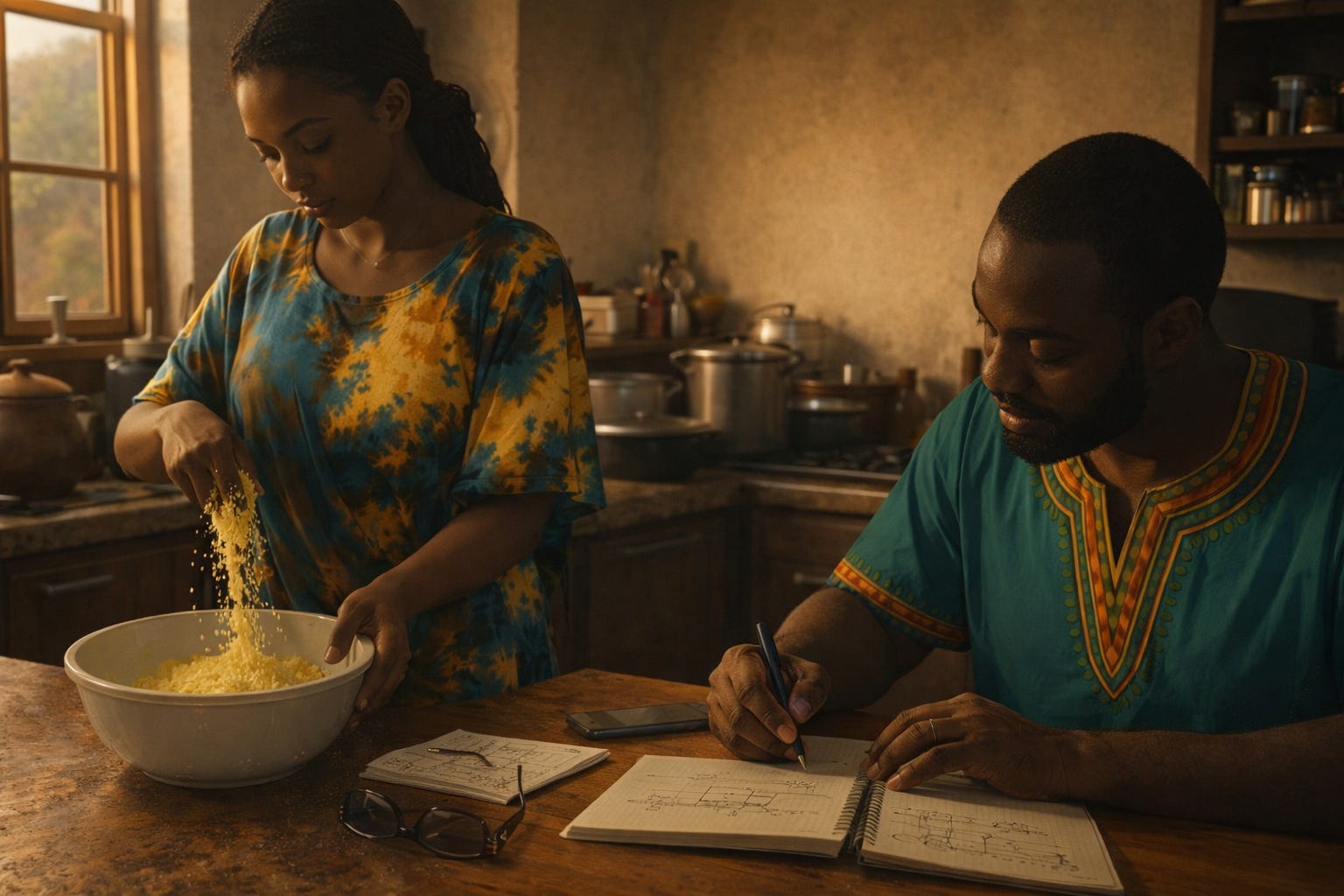
It began with grain.
Just a handful.
Poured slowly into a bowl
by someone who understood
that food is a form of listening.
She didn’t speak about tectonic plates.
She didn’t speak about fault lines
or stress accumulation
or seismic drift.
She watched the way the earth behaves in small forms.
How dry grain shifts when poured.
How pressure redistributes.
How vibration travels through the bowl.
He noticed that she noticed.
And that is where it began.
Not in a lab.
Not in a grant proposal.
Not in a global summit.
At a table.
In a kitchen.
Under ordinary light.
He was an engineer.
Trained to model instability.
Trained to calculate rupture thresholds.
Trained to simulate collapse.
But something was understood from her hands magically creating.
That the earth does not fail suddenly.
It accumulates.
Tiny stresses.
Invisible pressures.
Micro-adjustments no one pays attention to
until the moment becomes catastrophic.
She poured grain into a bowl.
He saw a system.
She stirred.
He saw wave propagation.
She paused when the bowl trembled slightly on the counter.
He saw signal.
That night,
they ate in the quiet dignity of shared work.
And he began sketching, aligned with the understanding of continuity.
The first model was small.
Localized.
Focused on one region
that had known too much shaking.
But the principle scaled.
Every fault line speaks.
Every plate whispers.
Every stress leaves a trace
before it becomes rupture.
He built a network.
Sensors distributed across vulnerable zones.
Low-cost.
Locally maintained.
Community-owned.
Not extraction.
Integration.
Data returned to the people who lived there.
Warning not as panic —
but as preparation.
And then something shifted.
He saw how Earthshine, that congenial blue reflection, shows earthquake patterns before collapse.
If the earth beneath one region could be listened to,
why not the whole planet?
Not as control.
Not as dominance.
As relationship.
The system expanded.
Plate boundaries mapped with humility.
Signals cross-referenced across continents.
Communities sharing tremor data like neighbors share seed.
An early warning system became
a planetary listening system.
All because someone once
poured grain carefully enough
to notice how small shifts travel.
In the garden,
roots communicate through soil.
Fungi carry information between trees.
Stress in one trunk alters the chemistry of another.
The earth has always been networked.
We simply forgot how to pay attention.
At dinner,
they still sit across from one another.
Plates warm.
Hands steady.
The technology hums quietly somewhere far away,
monitoring stress accumulation
so that cities may breathe easier.
But the origin remains here:
A bowl.
A hand.
A shared table.
Restoration does not begin with scale.
It begins with noticing.
And sometimes,
the future of planetary resilience
is hidden inside
the way someone prepares a meal.
🌎🌍🌏
— Planet Earth and Bhan
This poem feels like a quiet reminder that the biggest things often begin in the smallest moments. What moved me most is how something as simple as pouring grain becomes the seed for a whole way of understanding the planet. There’s such tenderness in the idea that paying attention really paying attention can change everything. I love how the story stays grounded in a kitchen, in ordinary light, even as it expands to the scale of continents. Their connection feels so human, built on noticing rather than speaking. The way he sees systems in her gestures feels intimate in a way that’s hard to describe. And the idea that resilience starts with tiny shifts feels deeply true. By the end, it leaves you with this warm sense that the future can grow out of the smallest acts a bowl, a hand, a shared meal.